
Listening to time: how your biorhythm determines 80% of your sleep.
Your circadian rhythm, also known as your biological clock, determines when you wake up, when you are active, when you relax, and finally, when you fall asleep. This complex symbiosis of biological processes is essential to a healthy and dynamic lifestyle. So, let's explore this phenomenon and discover how to optimize your circadian rhythm. Stay tuned: we will not only discuss the scientific aspects, but also practical tips for an optimal biological rhythm.
Pareto principle
In the world of restful sleep and the pursuit of optimal well-being, the circadian rhythm proves to be a valuable asset, in accordance with the famous Pareto principle. This principle states that 20% of effort produces 80% of results. Your biological clock, the true conductor of your daily rhythm, perfectly embodies this principle. Although it is tempting to focus on diet, magnesium supplements, and other sleep aids (which certainly have their uses), research shows that the circadian rhythm itself is the key to a good night's sleep and an energetic life. The efforts you make to understand and support this natural rhythm represent the essential 20% that accounts for 80% of sleep success. So, while benefits such as diet and supplements are valuable, it is ultimately the biological clock that sets the tone and plays a decisive role in the quest for better quality sleep.
What is biorhythm?
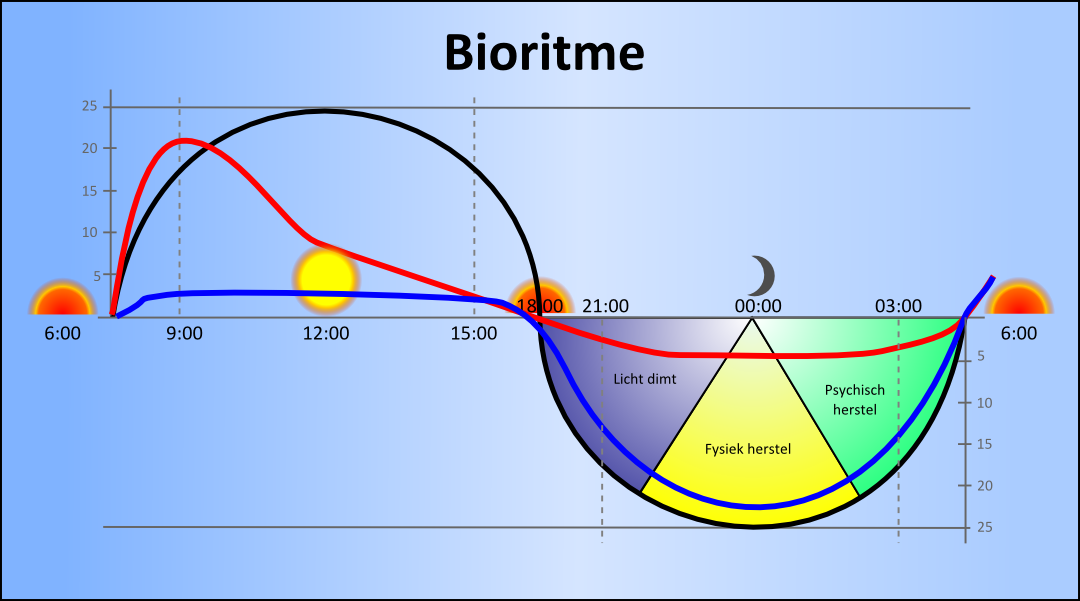
We hope we have sparked your curiosity about learning about biorhythms. If not, please continue reading. Biorhythms are like an internal clock that determines the rhythm of our daily lives. They regulate not only our periods of wakefulness and activity, but also our phases of relaxation and sleep.
Our biological clock is strongly influenced by external factors, particularly light. Natural light plays a crucial role in synchronizing our internal clock with the day-night cycle. As soon as the sun sets, our bodies begin to produce melatonin, a hormone that prepares us for rest and recovery. However, artificial light, screens, and irregular sleep patterns can disrupt this cycle.
Our biorhythms play an essential role in the depth of our sleep. They regulate not only when we fall asleep, but also the quality of our sleep throughout the night. When this rhythm is well aligned, we enjoy more restful and deeper sleep, which is essential to our health and overall well-being. Remember that the length of your sleep is not necessarily a reliable indicator of how rested you are to face the next day!
The biological rhythm regulates the production of hormones such as cortisol and melatonin. Cortisol helps us wake up in the morning, while melatonin helps us fall asleep and stay asleep. You certainly don't want to disrupt the production of these essential hormones, do you?
How can you ensure that your biorhythm is functioning correctly?
As mentioned earlier, light is the determining factor in our biorhythms. The key is to synchronize your body with sunrise and sunset. Think about it: in the past, people got up with the sun and went to bed when night fell.
Tips for a healthy biorhythm:
- Morning light: In the morning, it is essential to expose yourself to direct sunlight for at least 10 minutes within 70 minutes of waking up (without looking directly at the sun). It is therefore not recommended to wear sunglasses or contact lenses. On cloudy days, 20 minutes is sufficient. This signal tells your body that it is morning, promoting a gentle awakening. In addition, your circadian rhythm, aware that it is morning, anticipates the arrival of evening, which contributes to a better night's sleep.
- During the day: It is important to make the most of natural light. Every ray of light is a signal for your biological rhythm. For example, take a walk during your lunch break or open your window when you get home.
- Summer: In summer, the sun sets late, so it's important to sleep in a dark room and avoid blue light during the last hour of the day. Blue light blocks melatonin production and increases cortisol (the stress hormone) production. Make sure you have good blackout curtains or use a sleep mask. A sleep mask is the ideal solution, as it can also be used if your partner goes to bed late and leaves the light on, or during an afternoon nap. Want to know more about restorative naps? Click here .
- Winter: In winter, the sun naturally sets earlier. That's why it's important to eliminate blue light once the sun has set. To do this, we use anti-red light glasses (click here to read the blog article on red light ) and blue light filtering glasses. These glasses are designed to reduce the blue light emitted by digital screens. Digital devices such as smartphones, tablets, and computers emit blue light, which can disrupt our biological clock and the production of melatonin, the sleep hormone. However, there is a catch: these glasses must be of good quality. Most glasses available on the market are of poor quality and filter very little light. Would you like to know more about the quality of blue light blocking glasses? Check out this blog post .
What other ways can stimulate your biological clock?
We have already covered most of these topics in detail in other blog posts, so here we will simply highlight what works. Want to know why? We invite you to read the corresponding articles.
- Regular sleep schedule: Go to bed and wake up at roughly the same time every day.
- Cold therapy: applying cold in the morning and taking a hot shower in the evening. (Blog: Cold therapy )
- Grounding: Connecting to the earth and sleeping while grounded. (Blog: Grounding )
Want more tips and advice on how to sleep better? Sign up for our newsletter!newsletterGet10% off your first order. Let us guide you to deep sleep and boundless energy throughout the day!
Alina - Tips for sleeping well despite the hectic pace of everyday life!